Wednesday, 6 February 2013

The Temples of Siem Reap


Christina writes: Without a doubt, Angkor Wat is hands down the largest and most impressive temple in Siem Reap. Much anticipated, this temple delivered. Grand and imposing, ancient and intriguing. The temple was built by King Suryavarman II to represent Mt Meru - a holy place in Hindu mythology. It is the most important thing to Cambodia - the only reason tourists travel here and it is the national symbol - even on the country's flag.


However, as much as I loved Angkor Wat - my favourite temple was Bayon.

Bayon, located inside the temple city Angkor Thom, was built by King Jayavarman VII a few decades after Suryavarman II's death when the Cham people took over Angkor Wat. 

Here, 9 is the magic number.


54 gods line each side of the road - 5+4 = 9
54 towers, each with 4 sides, a face on each side - 216 faces 2+1+6 = 9
For me though, the carvings were extrordinary.


Fortune tellers - I wonder what future they predicted?

Farming, Cooking, Eating

Childbirth


Fighting, battles won and lost


Cock Fighting
Eskimo kissing in Bayon

Another temple worth mentioning - Neak Pean. This ancient hospital has four pools representing the four elements - Earth, Fire, Wind and Water. You access it by a long boardwalk over the water - a pretty walk and peaceful place.

Neak Pean, Built for the people.


Angkor What?

Craig Writes:  We've done the rounds of ancient temples and cities and here are my picks. 
Angkor Wat is number one on my Cambodian menu of temples to see. This massive complex has two miracles of engineering too account for. Firstly, the temple. Built in the 12th century it is an impressive 1002 metres x 802 metres. That's over 800,000 square metres of temples and towers. The central tower is 65 metres high. It is one of the largest religious monuments in the world.
Angkor Wat, east side
The west side and the reflection pond

It was originally built as a Hindu temple but when one king went and another stepped up he happen to fancy Buddhism, so, it became a Buddhist temple. It is that revered it's on the national flag and that sneaky SOB Pol Pot had his headquarters there during the civil war because he knew it was that highly respected no one would bomb it. There are numerous bullet holes around the outside and a couple of bombs were dropped close but never in the temple. Once again I gladly find myself tipping my hat to the ingenuity and vision of man at his best. It is estimated to have taken 5 million tonnes of sandstone to build. This had to be dragged and floated there from a mountain 40 klms away. 

Every surface has a relief on it of the most amazing detail. There are literally miles of them throughout the temple. Doors, walls and lintels were all carved to tell a thousand different stories. Engineers today say it would take 300 years to build in the modern era. A modern day stonemason recently tried to duplicate a section of the relief and it took him 22 days to finish 4 metres.

Every conceivable surface beautifully carved
The detail was astounding
On and on and on it goes
If a picture tells a 1,000 words...

This entire massive complex was completed in 37 years. AND, it was covered in gold leaf from head to toe. AND, this included the construction of a man made moat 3.6 kilometres around the entire site, 200 metres wide and 6 metres deep. The wall surrounding the site was 8 metres high. AND, the entire site was built on swamp land. It was on top of a fluctuating water table that would crack the foundations of anything built on it within the first few rainy seasons. This thing has been standing for a thousand years. AND, there is no cement or glues used to hold it together. Like Me Son in Vietnam, one piece on top of another. AND, well that should be enough, don't ya think?

Number two on my tasty temples menu would be Ta Prohm.

Not because I'm an Angelina Jolie fan and snippets of Tomb Raider were filmed there, because I'm not and it was a crap film. No, this is number two with a nod to Mother Nature because of the amazing and spectacular choke hold she has put on the place. Over the last four hundred years two demons of the tree kingdom, namely the the Silk Cotton Tree and the fabulously named, Strangler Fig have wrestled with the foundations and structure of this once great 12th century temple and have emerged clear winners. Their massive root systems have that intimately entwined themselves with the very fabric of the stonework that to try and separate the two would be a death sentence for them both. The roots look like prehistoric pieces of ginseng or ginger that would choke a T Rex and the root formations are a wonder of shapes and images. A cascading waterfall here, a giant python there and eerily a complex and thick curtain of roots that has grown around a small relief of Shiva leaving just the face exposed. 

A thousand year old picture frame
I once read that if humans disappeared, within 1,000 yrs you wouldn't know we'd been here.
Seeing this, I believe it
I love that in the end Mother Nature is still going to win
Look closely, can you find Shivas smiling face?
Banteay Srei - aka The Lady Temple. Number three with a bullet. There is something very special about this 10th century temple built entirely in red sandstone. It's on a small scale compared to the others and unlike all the other temples, was originally constructed by a member of the kings court and not the king himself. It was mostly completed before the nobleman ran out of money and construction halted for some time before the king put his hand in his pocket and finished it. What makes this temple sooo special, are the carvings and inscriptions. The detail is phenomenal. Angor Wat and the others are world class but here the cream has risen to the top. They call it the lady temple because they believe that the patience required for the delicate nature of carving this fine, this intricate, could only have been done by women. While carvings else where have been a few mm to maybe one cm deep, these have a depth of two to three cm, giving all the reliefs a sense of depth not achieved anywhere else.
A temple small in size but BIG in detail
Only red sandstone was used to give it that pinkish hue
Detail like nothing else we had seen
Precise, delicate and over one thousand years old

Angkor Thom. The Great City. In the category of ancient cities in S.E.Asia this is my number one, Built in the 12th century, again, this was the last and greatest of the Khmer Empires cities. It was 9 sq kms with a 12 kilometre hand dug moat, complete with crocodiles, and an eight metre high wall. It was home to over 80,000 members of the royal court, noblemen and generally rich families. It was abandoned when the economic and political capital were moved to Phnom Penh and rediscovered when the French moved in in the 1800's.

One of five causeways into the city
The faces are thought to represent the King
The early inhabitants must have felt very special living here

The Tonle Sap. The Great Lake. The largest fresh water lake in S.E Asia. It supports over three million people who live around it and on it. That includes approximately 700 floating villages. This thing is one of gods cruel jokes. In the dry season the lake covers 2700 sq klms and is one metre deep. In the wet season it erupts to 15,000 sq klms and up to NINE METRES deep. Can you imagine, one minute you've got lake side property next minute just lake. Reality Check Time. We think our world has fallen apart when the bath overflows and the carpet gets ruined. 

On the upside, this massive pulsing system with it's high annual influx of nutrients and sediment makes it the most fertile breeding ground for fish in S.E Asia. Not only does it support a population of millions it accounts for 75% of all of Cambodia's fresh water fish.
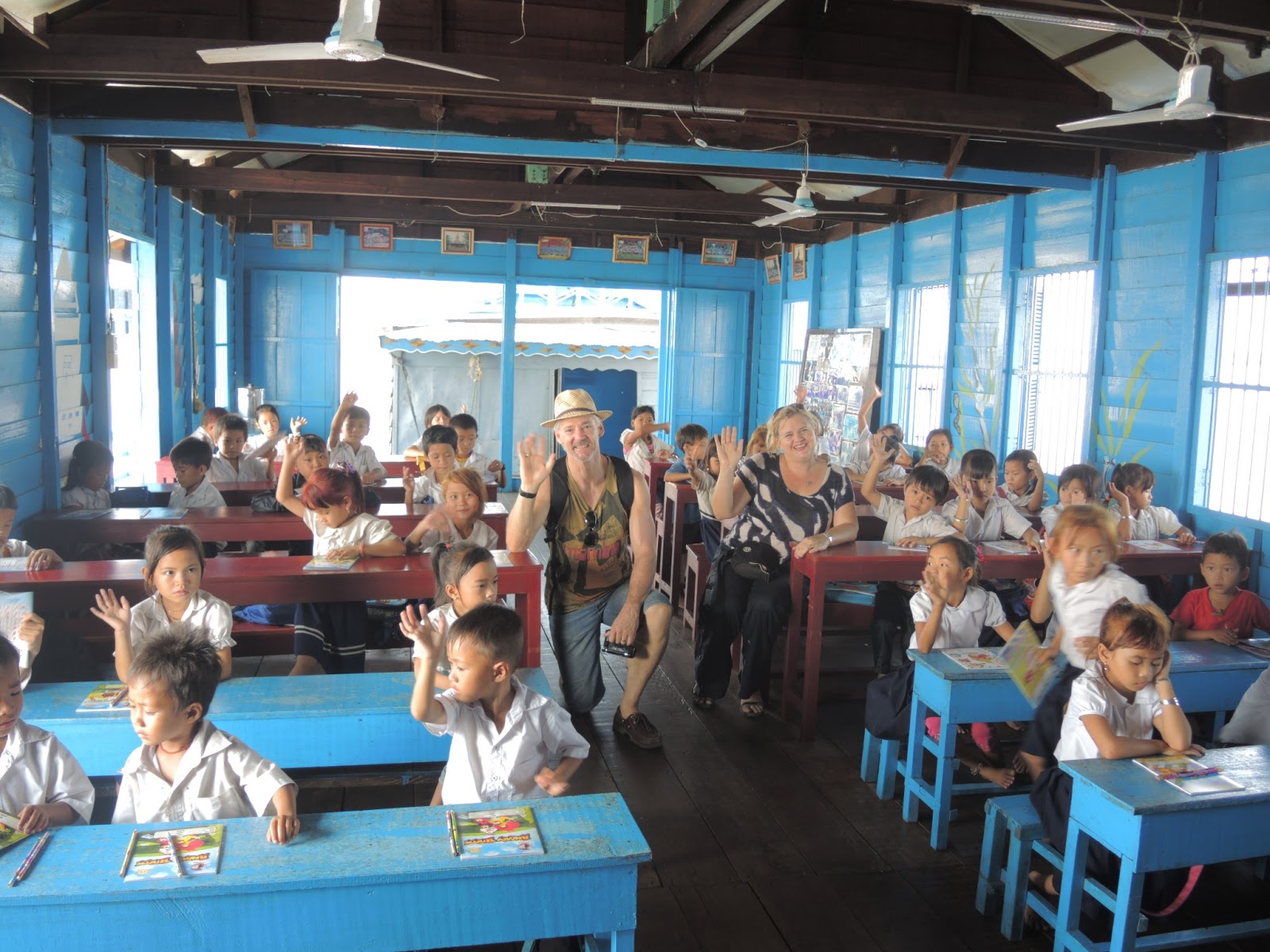
We got to play Mr and Mrs Santa today when we visited a couple of the floating schools. We took books, pencils and a big stash of hotel toiletries I had been collecting. You'd never believe a young kid would be so happy to get a small boxed sewing kit or a toothbrush.


Just popping into the shops
Often the shops will come to you

These kids were so polite, lots of thank you's. Beautiful manners
See that red framed square on top of the striped pole?
 That my friends is the high tide mark in the wet season.

Monday, 4 February 2013

Cambodia, A Tragic Past, An Uncertain Future


Craig Writes: We arrived at the airport in Cambodia after what seemed like a 12 minute flight. No sooner were we buckled in and leaving Saigon than our wheels were skidding along the Cambodian tarmac. It was only a 7 km trip from the airport to Siem Reap and our hotel. It's taken me a few days to get my head around the place and the people here. Unlike Vietnam where you feel a genuine confidence, calmness and strength, here something didn't feel quite right and its taken me a while to try to understand it. Thankfully our guide has been brilliant and very candid in sharing with me his thoughts and feelings about the place. But I notice always with an eye to who is within ear shot and always in hushed tones. I can't talk about Cambodia without first acknowledging a couple of things. Firstly, the Khmer Empire was once the most powerful empire in the region. Encompassing parts of Laos , Vietnam and Thailand. They won battles, acquired territory and built magnificent temples and cities. The likes of which the world had never seen. They were a proud and prosperous people. From the late 13th centuries with battles being lost and territory being seceded, the capital was moved from the north in Angkor to further south near Phnom Penn. With that move the great temples and cities of Angkor fell into disrepair and were lost to the world for over 400 years. Lost battles and poor leadership saw the country lose territory and power. There were constant battles with Thailand and Vietnam. Even today there is tension between them. The last century and a half have also not been kind to them. The French took control around 1860 and stayed there until they were removed in 1954.

The second thing, and undoubtedly the most devastating chapter in the history of the country, was the reign of Pol Pot. This murderous piece of crap came to power through executing the leader of his own party. He effectively controlled the country from 1963 till he was ousted in 1979, but he still held great influence within the country until the late 80s. During the four most devastating years of his reign of terror, 1975 to 1979, he would go on an insane rampage that would kill up to 2.5 million of his own people. 25% of the population. Approximately half through execution, the rest starved to death. He closed down and evacuated all the cities and towns and moved everyone to the country under the premise there was to be a huge American bombing campaign and everyone could return shortly. His actual plan was to forge an agrarian society where nobody owned anything and all work for the common good. Namely him. His logic was he only needed a population of around 2 million to realise this and the population at the time was 8 million. So, the best way to cull them all was to move them to the country, ban fishing, cut down fruit trees, restrict farming, ban religion and education, kill anyone that could spell their own name and ban medicines and hospitals and let the strongest 2 million survive. A truly despotic man who deserved much more than a soft life in exile in China and to die in his bed in 1998.
The government today is the same quasi dictatorial one that has been ruling for the last 30 years. There are "elections" due this year but the "opposition" is banned from promoting themselves and their party. The general public can be arrested for talking about the elections in public. Corruption is rife. The police have two price ranges for a fine. 100% if you want a receipt , 50% if you don't. There was a policeman at one of the temples today offering to sell police badges to tourists for a souvenir . Government workers can have their pay stopped for up to 3 months if the government is running a bit short on funds. If you get seriously sick or injured and you or your relatives cant afford to pay, they'll literally push you to one side to die. And, there are still prearranged marriages where you have to pay a dowry of between $US 5000 to $US 7000.
With the memory of that evil bastard still so fresh in the minds of the people, no one is willing to risk any more upsets. The government made a deal with the devil when they accepted help from the Vietnamese to stop Pol Pot. The Vietnamese now have a mortgage on most of the big temples, including Ankor Wat. They have positions in the government and have invested billions in the country. Of the current population of 14 million, 2 million are Vietnamese. The government, read filthy pocket lining bureaucrats and politicians are getting rich by selling off development rights to various other countries. 
So, now having a bit more information I can now try to put my thoughts into words. I think beneath the thin smiles and well rehearsed words their is a lot of fear, resentment and sadness here. With the influx of overseas money and promotion of their country comes a flood of tourists. With that comes stories of other lives being lived with opportunities abounding and dreams being fulfilled. Things seemingly beyond them. When I discuss with our guide about our lives back in Australia he shakes his head but more in despair than wonder or envy. When you come across street sellers there is desperation on their faces. I think people here are still shell shocked. Shell shocked from the hell on earth they endured for four long years and now shell shocked by the rapid sell off of their country and this meteoric influx of foreigners and all their money and their endless stories. I think they are genuinely fearful of losing their identity as Cambodians as more and more Vietnamese and Koreans come into the country with their deep pockets and government contacts. Buying up or setting up all the businesses and then importing their own people to work them while the Cambodians beg for change in the street.
Before the killing spree Siem Reap had a population of around 100,000. At the end of 1979 it had approximately 1000. By the year 2000 it had grown to 10,000. Over the last 12 years, fuelled by the explosive interest in their ancient temples and cities, particularly Ankor Wat and Ankor Thom , the population has soared to nearly 1,000,000. They have built over 170 hotels, some commanding $3500 per night. There are over 250 guest houses and 400 restaurants. They are trying hard and at the moment the cracks are easy to see. You can only hope for them that with the opportunities that come with the tourism and the investment that they get there fare share.

Friday, 1 February 2013

Homestays, Elephant Ears and The Mekong

Craig Writes: A 7.30am start for our two hour drive to LonGan, the first province in the Mekong Delta. Here we catch our private boat for a four hour trip up the Mekong River. Our destination is Vinh Long, third province and the destination for our home-stay. There were to be various stops along the way. This trip reinforced my understanding of how ingenious these people are. They use every opportunity Mother Nature gives them to feed, house and protect themselves. There isn't a pond, a stream or a lake that doesn't have fish in it. Outside of the Mekong Delta, catfish is the preferred fish of choice. In the Mekong Delta, it's Elephant Ear fish for breakfast, lunch and dinner. If they don't have a pond to farm a fish they'll dig one in from the nearest source of water. If there's a bit of land they'll plant something on it, rice, bananas, guava, something.
The Mekong River is 4350 kms long. It starts in the Qinghai province in South East China and flows through Laos, Cambodia and Vietnam draining into the South China Sea just south of Ho Chi Minh city. It varies in width from 1 to 5 kms and serves the complete needs of the Mekong Delta. A 14,000 sq mile district broken into 13 provinces with a population of 18 million people. They live, bathe, farm, transport their goods and play in it, on it and along the entire length of it. A popular crop along the shore line are water hyacinth. There everywhere. The leaves they use to feed their pigs and the roots are dried to weave into handbags.
Life by the Mekong
Life in the Mekong
Water Hyacinth; hand bags just waiting to be made
Our first stop was an Asian candy store unlike anything you would see at home. First we watched them make rice popcorn. You start with buckets of black sand pulled from the river and super heated in an enormous wok. When its ready they add ladles of rice with the husk freshly removed. Bingo, within seconds it starts popping like a fiend, and like rabbits out of a magicians hat, suddenly appear hundreds of bouncy white rice puffs. It is then sifted to remove the black sand and any remaining husks. They reuse the black sand. Once it's cooled they add honey, sesame seeds and nuts. Brilliant. They use the husk from the rice to fuel the fire. Same when they make the candied coconut. The coconut husk and shell are used to fuel the fire that heats the pans. 
Super heated black sand
From boring  rice to poprice
The finished product with some sweet, sweet tea
They had some large glass jars of snake wine and rice wine brewing. I gave the snake wine a miss and opted for a small thimble of the rice wine. 40 percent proof. Kapow! And what candy store isn't complete without a 10 foot python. Of course you can't walk pass the opportunity when the friendly candy man offers to drape it over your shoulders. Callum went first, tentative, but he did it. Good on ya buddy. When they drape the monster over your shoulders the first thing you realise is how heavy it is. As soon as it lands on you you can feel the first gentle squeeze as it starts to slither and wind itself around your body. You certainly get the impression its feeling you out, positioning itself in case you make to sudden a move. It gave my leg a pretty friendly squeeze. Just enough to give you a bit of an idea of what it could do if it wanted to. 
40 proof snake wine, it's got real bite. (sorry)
This looks one small squeeze away from a curtain call
Careful fella, that's my ticklish spot
Charlie prefers his snake a little off the shoulder
Further up the river it was into a tropical fruit farm for a tasting of Jack fruit, plums (best eaten with chilli salt) tiny bananas the size of your thumb and as sweet as honey, guava, watermelon and papaya . The locals put on a little show here. Three musos and three singers. It wasn't Vegas but they put everything into it. Acting out their roles of the farmer lamenting the late arrival of his tardy wife with his lunch or the two young lovers hunting for crabs and fish. They went for it like it was Simon Cowell sitting in front of them, not just four anonymous tourists from down under. I thought they were brilliant.
Back on the boat and I sat up on the bow for a while. So nice to have a fresh strong breeze in my face and not the steady fug of recycled bike fumes that comes through the minibus aircon. As we turn into a narrow tributary we jump over the corrugated wake of another boat turning in front of us to rejoin the Mighty Mekong. It was packed tight with day tourists. As we were over-nighting we had our boat to ourselves. Once we've turned off the main river we slow to a crawl. The water is only about 50cm deep and littered with debris from the locals who live along it's banks. Our driver negotiates carefully to avoid getting anything wrapped around the propellor, unsuccessfully as it turns out. He has to jump into the muddy and ugly water to pull out metres of colourful plastic from around the propeller. In the meantime we literally get passed by an old man in a Zimmer boat . This ancient fossil of a fella sits bent at the front of his decrepit old vessel. It looks like it may have been a life boat off Noahs Ark. He slowly glides by us with slow, casual strokes of a paddle. Pushing himself off the bottom of the river. He doesn't bother to look at us.
Propeller Food
"Amateurs"
"Eat my wake people"

With the propellor free we're off but its slow going and the fresh breeze has long gone. The way here is very narrow with relatively steep sides. It must be a significant short cut to go through here. We finally break through the other side onto a more major tributary and the air suddenly clears. Here for lunch and our first taste of Elephant Ear Fish, crispy skinned and delicious. The meat comes off the bones cleanly and you roll in in rice paper with cucumber, mint and lettuce then dip it in a sweet chilli sauce. Mighty fine. The flesh is sweet, flaky and delicious. A most unusual fruit for desert. Its called Longan, or Dragon Eyes. All I can say is check out the photo. Damn freaky.
Apologises for this, it's off.
Elephant Ear fish, very tasty
The homestay was more a B and B or a guest house. We were expecting to schmoose with the locals, have long chats over dinner and a few carafes of rice wine. Find some kind of cross cultural common ground to bond over and leave with fond memories of getting drunk and falling out of a coconut tree. But alas no. We got to make some spring rolls in their kitchen but that was it. Then it was out on our lonesome in the dining pagoda under a ceiling fan sipping on a warm Tiger beer and eating more Elephant Ear fish. The CVW'S still had fun though.
The homestay
Oh, how we laughed
Up early the next morning for a quick trip back down the Mekong to a local brick factory built on the banks of the river. Another step back in time. This must be where Fred and Wilma bought there bricks from. They pull the mud from the river then mould it into whatever kind of brick they want. Its dried for a few days in the sun then placed into these enormous kilns and baked for 10 to 15 days. The kilns are fuelled by nothing more than rice husks. A literal mountain of the stuff. See the photo. 
Bedrock Brick Kilns
He's there to stop the chooks eating the furnace fuel
Thanks for the tour  people
From here it was a trek back to the Family Inn. Early night and off to the the airport the next morning. It was a sad farewell to Vietnam but definitely not goodbye. We'll be back. 

Some Closing Observations;
  • They drive like maniacs
  • They have no fear
  • Their coffee tastes like strong cocoa
  • No one has a beard - they call it "special hair"
  • There are no fat Vietnamese 
  • Their resilient, inventive and very resourceful
  • If you stand still for too long in one spot they'll grow something on you
  • There are more motor bikes than flys
  • Its better to be a pet in the south than the north
  • Saigon is beautiful , Hanoi is not
  • You can run your bike on rice wine if you have to
  • Stuff is cheap
  • Food is fantastic
  • Vietnamese girls can be stunners
  • There is something amazing, bizarre and surprising around every corner
  • There is no malice here
  • There are no slackers here
  • They smile all the time